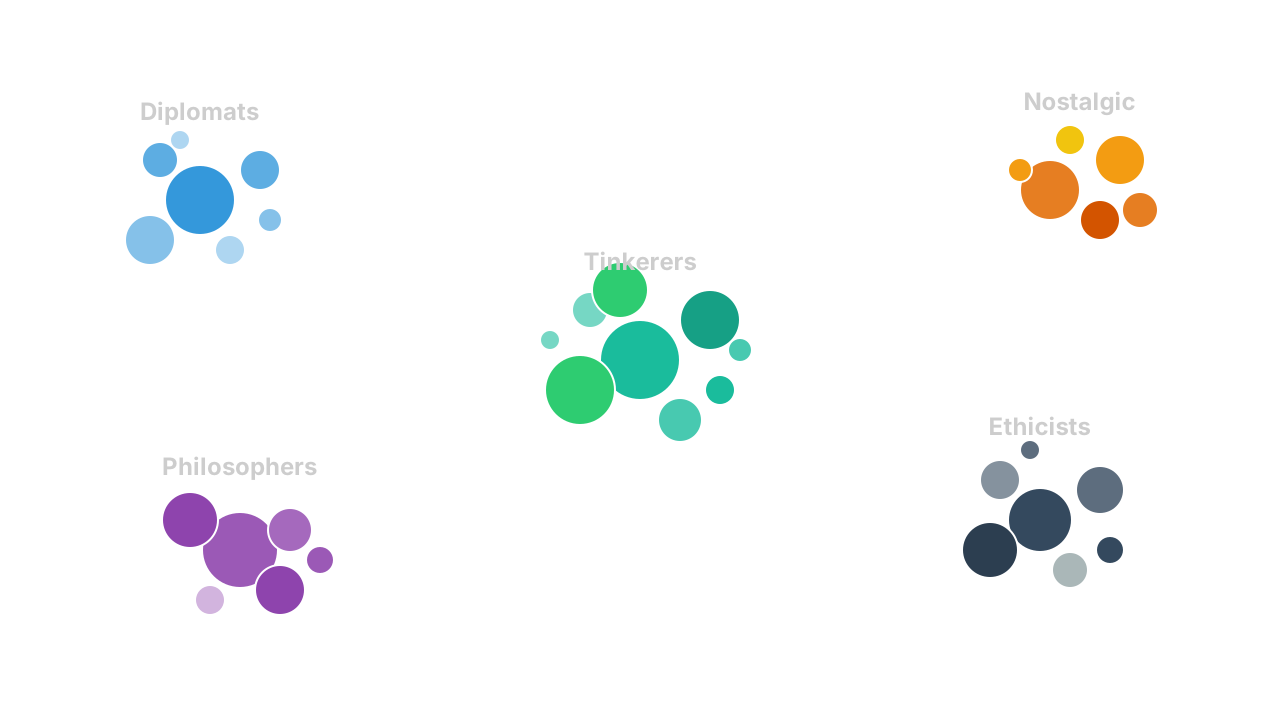

Whenever one of my articles reaches some popularity, I tend not to participate in the discussion. A few weeks back, I told a story about me, my neighbor and an UHF remote. The story took on a life of its own on Hackernews before I could answer any questions. But reading through the comment section, I noticed a pattern on how comments form. People were not necessarily talking about my article. They had turned into factions.
This isn't a complaint about the community. I've made this observation years ago but didn't have the words to describe it. Now I have the articles to explore the idea.
The article asked this question: is it okay to use a shared RF remote to silence a loud neighbor? The comment section on hackernews split into two teams. Team Justice, who believed I was right to teach my neighbor a lesson. And then Team Boundaries, who believed I was “a real dick”. But within hours, the thread stopped being about that question. People self-sorted into tribes, not by opinion on the neighbor, but by identity.
The tinkerers joined the conversation. If you only looked through the comment section without reading the article, you'd think it was a DIY thread on how to create an UHF remote. They turned the story into one about gadget showcasing. TV-B-Gone, Flipper Zeros, IR blasters on old phones, a guy using an HP-48G calculator as a universal remote. They didn't care about the neighbor. They cared about the hack.
Then came the apartment warriors. They bonded over their shared suffering experienced when living in an apartment. Bad soundproofing, cheap landlords, one person even proposed a tool that doesn't exist yet, a "spirit level for soundproofing". The story was just a mirror for their own pain.
The diplomats quietly pushed back on the whole premise. They talked about having shared WhatsApp groups, politely asking, and collective norms. A minority voice, but a distinct one.
Why hack someone when you can have a conversation?
The Nostalgics drifted into memories of old tech. HAM radios, Magnavox TVs, the first time a remote replaced a channel dial. Generational gravity.
Back in my days...
Nobody decided to join these factions. They just replied to the comment that felt like their world, and the algorithm and thread structure did the rest. Give people any prompt, even a lighthearted one, and they will self-sort. Not into "right" and "wrong," but into identity clusters. Morning people find morning people. Hackers find hackers. The frustrated find the frustrated. You discover your faction. And once you're in one, the comments from your own tribe just feel more natural to upvote.
This pattern might be true for this article, but what about others? I have another article that has gone viral twice. On this one the question was: Is it ethical to bill $18k for a static HTML page?
Team Justice and Team Boundaries quickly showed up. "You pay for time, not lines of code." the defenders argued. "Silence while the clock runs is not transparent." the others criticized. But then the factions formed. People self-sorted into identity clusters, each cluster developed its own vocabulary and gravity, and the original question became irrelevant to most of the conversation.
Stories about money and professional life pull people downward into frameworks and philosophy.
The pricing philosophers exploded into a deep rabbit hole on Veblen goods, price discrimination, status signaling, and perceived value. Referenced books, studies, and the "I'm Rich" iPhone app. This was the longest thread.
The corporate cynics shared war stories about use-it-or-lose-it budgets, contractors paid to do nothing, and organizational dysfunction. Veered into a full government-vs-corporations debate that lasted dozens of comments.
The professional freelancers dispensed practical advice. Invoice periodically, set scope boundaries, charge what you're worth. They drew from personal contractor experience.
The ethicists wrestled with whether I did the right thing. Not just "was it legal" but "was it honest." They were ignored.
The psychology undergrads were fascinated by the story. Why do people Google during a repair job and get fired? Why does price change how you perceive quality? Referenced Cialdini's "Influence" and ran with it.
Long story short, a jeweler was trying to move some turquoise and told an assistant to sell them at half price while she was gone. The assistant accidentally doubled the price, but the stones still sold immediately.
The kind of drift between the two articles was different. The remote thread drifted laterally: people sorted by life experience and hobby (gadget lovers found gadget lovers, apartment sufferers found apartment sufferers). The $18k thread drifted deep: people sorted by intellectual framework (economists found economists, ethicists found ethicists, corporate cynics found corporate cynics). The $18k thread even spawned nested debates within subfactions. The Corporate Cynics thread turned into a full government-vs-corporations philosophical argument that had nothing to do with me or the article.
But was all this something that just happens with my articles? I needed an answer. So I picked a recent article I enjoyed by Mitchell Hashimoto. And it was about AI, so this was perfect to test if these patterns exist here as well.
Now here is a respected developer who went from AI skeptic to someone who runs agents constantly. Without hype, without declaring victory, just documenting what worked. The question becomes: Is AI useful for coding, or is it hype?
The result wasn't entirely binary. I spotted 3 groups at first. Those in favor said: "It's a tool. Learn to use it well." Those against it said: "It's slop. I'm not buying it." But then a third group. The fence-sitters (I'm in this group): "Show me the data. What does it cost?"
And then the factions appeared.
The workflow optimizers used the article as a premise to share their own agent strategy. Form an intuition on what the agent is good at, frame and scope the task so that it is hard for the AI to screw up, small diffs for faster human verification.
The defenders of the craft dropped full on manifestos. “AI weakens the mind” then references The Matrix. "I derive satisfaction from doing something hard." This group isn't arguing AI doesn't work. They're arguing it shouldn't work, because the work itself has intrinsic value.
The history buffs joined the conversation. There was a riff on early aircraft being unreliable until the DC-3, then the 747. Architects moving from paper to CAD. They were framing AI adoption as just another tool transition in a long history of tool transitions. They're making AI feel inevitable, normal, obvious.
The Appeal-to-Mitchell crowd stated that Mitchell is a better developer than you. If he gets value out of these tools you should think about why you can't. The flamewar kicked in! Someone joked:
"Why can't you be more like your brother Mitchell?"
The Vibe-code-haters added to the conversation. The term 'vibe coding' became a battleground. Some using it mockingly, some trying to redefine it. There was an argument that noted the split between this thread (pragmatic, honest) and LinkedIn (hyperbolic, unrealistic).
A new variable from this thread was the author's credibility, plus he was replying in the threads. Unlike with my articles, the readers came to this thread with preconceived notions. If I claimed that I am now a full time vibe-coder, the community wouldn't care much. But not so with Mitchell.
The quiet ones lose. The Accountants, the Fence-Sitters, they asked real questions and got minimal traction. "How much does it cost?" silence. "Which tool should I use?" minimal engagement. The thread's energy went to the factions that told a better story.
One thing to note is that the Workflow Optimizers weren't arguing with the Skeptics. The Craft Defenders weren't engaging with the Accountants. Each faction found its own angle and stayed there. Just like the previous threads.
Three threads. Three completely different subjects: a TV remote story, an invoice story, an AI adoption guide. Every single one produced the same underlying architecture. A binary forms. Sub-factions drift orthogonally. The quiet ones get ignored. The entertaining factions win.
The type of drift changes based on the article. Personal anecdotes (TV remote) pull people sideways into shared experience. Professional stories ($18k invoice) pull people down into frameworks. Prescriptive guides (AI adoption) pull people into tactics and philosophy. But the pattern, like the way people self-sort, the way factions ignore each other, the way the thread fractures, this remained the same.
The details of the articles are not entirely relevant. Give any open-ended prompt to a comment section and watch the factions emerge. They're not coordinated. They're not conscious. They just... happen. For example, the Vibe-Code Haters faction emerged around a single term "vibe coding." The semantic battle became its own sub-thread. Language itself became a faction trigger.
Now that you spotted the pattern, you can't unsee it. That's factional drift.



Join the Conversation