

After watching a Veritasium video, I feel a surge of intellectual confidence. I feel smarter. Whether it's a video on lasers or quantum physics, it seems like I have a better grasp on the subject. I finally get it. Derek and his crew just have a way of simplifying complex ideas and lifting your confidence as each term is explained.
Every video they release is logically sound. Almost as if I could have come to the same conclusion if I had spent enough time researching. Except I only spent 30 minutes watching the video. And now, whenever someone brings up quantum physics or lasers, the bells ring in my head.
"Oh, I know quantum physics."
And then I try to explain.
"So it's all about uncertainty. You have the qubit, and it can be zero or one... or both. Wait no, that's quantum computers. Quantum physics is more about strings. When things are much smaller than atoms, the rules are different. And then one particle can affect another particle, even at a large distance. Even if it's on the other side of the universe. Trust me, it's very interesting. You just have to watch the video."
You should watch the video indeed. The problem is that Derek understood the subject and explained it confidently. What we do is watch it passively and pick up on his confident tone. It's the illusion of understanding, an afterglow of a compelling narrative delivered with authority. Teaching or explaining is like a reality check for our knowledge. If you want to know how well you understood a subject, try explaining it. You'll quickly differentiate your confidence from your competence.
With YouTube videos, you at least have to watch the whole video to develop that confidence. But with ChatGPT, you just type a question, and an authoritative voice presents you with all the information you need to win an argument. This argument is usually delivered via screenshot and shared on social media as proof for whatever statement is being defended.
LLMs have accelerated this confidence in people without necessarily improving our knowledge. For the most part, when people quote an LLM, they don't read past the part that agrees with them. It's even better when it's a Google AI overview that highlights just the part you need and can never be cited.
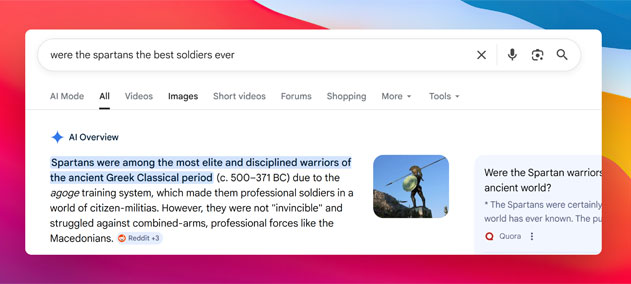
The medium is the message. With LLMs, we seek answers, not knowledge. It's almost as if the time spent researching is directly proportional to the amount of information we retain. If you watch a 60-second fast-paced video that teaches cooking hacks on TikTok, it probably won't turn you into a cook. You'll be entertained though and have the confidence of a cook.
When you ask an LLM to explain a complex subject, you can read it through and understand it in that one sitting. But you probably won't grasp it enough to apply it or explain it to someone else.
But fear not, it's not all doom and gloom. You can learn about quantum physics from a video. First, you should try explaining it to see if you understand it. If not, you can re-watch it actively. Take notes, read more articles, immerse yourself in the subject. Turn entertainment into education by doing something with the information. Sketch it on paper, talk about it with peers interested in the subject. I have a colleague who is deeply into physics, we hardly ever talk about work at work together. You'd be surprised by your coworkers secret passions.
If you're going to use an LLM to understand, read all the material and have follow-up questions that you can revisit in the future. The point is to turn that initial confidence into active participation that motivates you to learn more.
But most importantly, avoid the temptation of the medium. When you watch a fascinating lecture on YouTube, the most natural thing to do next is to watch another fascinating video on YouTube. Avoid this at all costs because there are infinite videos to watch.
Having confidence after watching interesting content or reading an LLM response isn't a bad thing. But it should be used as motivation to dig deeper. Otherwise, it's just vanity.



Join the Conversation