

Sometimes, I have 50 tabs open. Looking for a single piece of information ends up being a rapid click on each tab until I find what I'm looking for. Somehow, every time I get to that LinkedIn tab, I pause for a second. I just have to click on the little red dot in the top right corner, see that there is nothing new, then resume my clicking. Why is that? Why can't I ignore the red notification badge?
When you sign up for LinkedIn for the first time, it's right there. A little red dot in the top right corner with a number in it. It stands out against the muted grays and blues of the interface. Click on it, and you'll discover you have a notification. It's not from someone you know; this is a fresh new account, after all. But the dot was there anyway.
Add a few connections, give it some time, and come back. Refresh the page, and you'll have new notifications waiting.
If your LinkedIn account is like mine, a ghost town, you still get the little red dot. My connections and I usually keep a few recruiters in our networks, an insurance policy in case we need to find work quickly. But we rarely, if ever, post anything. Yet whenever I log in, there's a new notification. Sometimes it's even a message, but not from anyone in my connections list. It's from LinkedIn itself.
The little red dot isn't exclusive to LinkedIn. My Facebook account has been dormant for years, yet those few times annually when I log in, the notifications are right there waiting for me. I've even visited news websites where the little red dot appeared for reasons I couldn't understand. I didn't have an account, so what exactly were they notifying me about?
That little red dot is a sophisticated psychological trigger designed to exploit the brain. It activates the brain's Salience Network. Think of it as a circuit breaker that alerts us to immediate threats. When triggered, it signals that the brain should redirect its resources to something new.
The color red is not chosen by accident either. On my Twitter app, the notification is a blue dot, which I hardly ever notice (don't tell them that). But red triggers our brain to perceive urgency. We feel compelled to address it immediately.
The little red dot fools us into believing that something trivial is actually urgent. Check your phone and you'll notice all the app icons with a little red dot in their top right corner. Most, if not all, social media alerts function as false alarms, and they gradually compromise our ability to focus on what matters.
Whenever you spot the little red dot, you feel compelled to click it. It promises a new connection, a message, a validation of some sort. It doesn't matter that you are almost always disappointed afterward, because you will be presented with content that keeps you scrolling, never remembering how you got there.
Facebook used to show the little red dot in their email notifications. When there is activity on your account, say you were tagged in a photo, Facebook sends you an email and in the top right corner, they draw a little red dot on the bell icon. Obviously, you have to click it so you don't miss out.
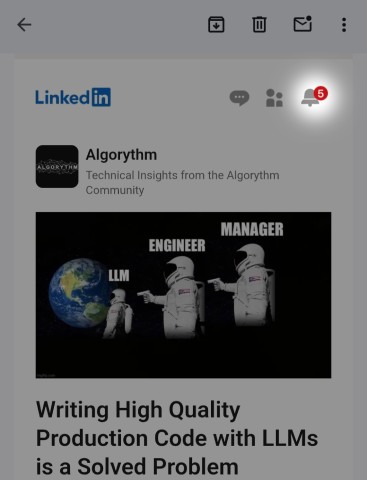
Note: my old facebook emails have broken images, but linkedin just sent me a new email with the red dot in it.
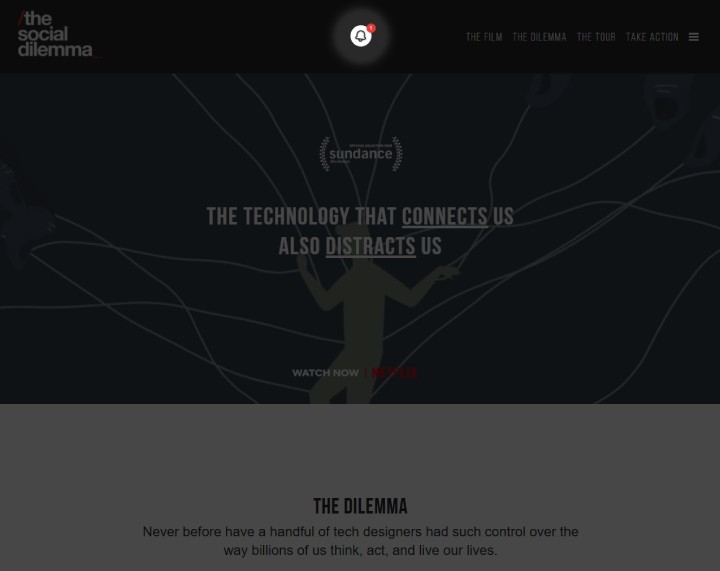
There was a Netflix documentary released a few years ago called The Social Dilemma, an inside look at how social media manipulates its users. Whether intentional or not, their website featured a bell icon with a little red dot on it. You visit the site for the first time, and it shows that you have one notification. There's no way around it, you are psychologically enticed to click.
A notification is supposed to be a tool, and a tool patiently waits for someone to use it. But the little red dot seduces you because it wants something from you. It's all part of habit-forming technology: the engagement loop.
The engagement loop follows three steps: a cue (the notification), a routine (an action such as scrolling), and a reward (likes, a dopamine hit). From the social media platform's perspective, this is a tool for boosting retention. From the user's perspective, it's Pavlovian conditioning.
For every possible event, LinkedIn will send you a notification. Someone wants to join your network. Someone has endorsed your skills. A group is discussing a topic. Each notification generates a red dot on your mobile device, pulling you back into actions that benefit LinkedIn's system.
In the documentary, they show that this pattern is just the tip of the iceberg. Beneath the surface lies a data-driven, manipulative machine that feeds on our behavior and engineers the next trick to bring us back to the platform.
For my part, I've disabled notifications from all non-essential apps. No Instagram updates, no Robinhood alerts, no WhatsApp group messages. I receive messages from people I know. That's pretty much it. For everything else, I have to deliberately seek out information.
That said, I did see another approach in the wild. Some people simply don't care about notifications. Every app on their phone has a little red dot with the number "99" on it. They haven't read their messages and aren't planning to. You're lucky if they ever answer your call. I'm not sure whether this is a good or bad thing... but it's a thing.
That little red dot represents something larger than a notification system. It's the visible tip of an infrastructure built to capture and commodify human attention. The addictiveness of social media isn't an unfortunate byproduct of connecting the world. Right now it's the most profitable business model.
The more addictive the platform, the more you engage; the more you engage, the more advertisements you see. This addiction shapes behavior, consumes time, and affects mental wellbeing, all while companies profit from it.



Join the Conversation