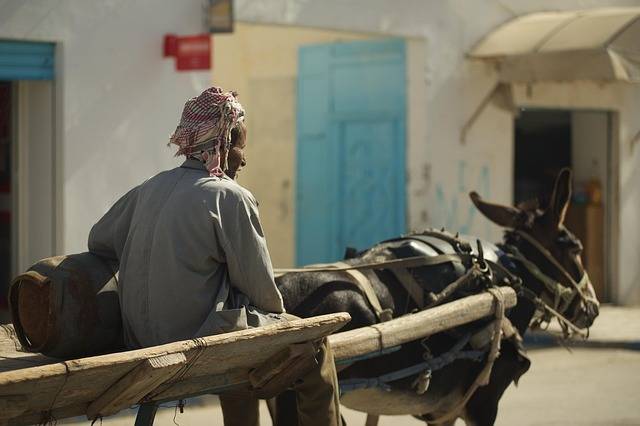
The screech of tires, the panicked cry of 'Donkey!', and the slow-motion arc of a cart flipping through the air! That's the memory that comes to mind whenever I think of driving in Cairo Egypt. My first car accident, a baptism by fire in the controlled chaos of Egyptian roads, wasn't caused by a speeding taxi or a reckless motorbike. It was a donkey, and its cart, materializing out of my blind spot like a mirage. In the frantic search for merging traffic, my peripheral vision failed me, and my foot, guided by adrenaline, found the gas pedal instead of the brake.
The cart flipped, and I watched, horrified, as the donkey joined it in a brief, gravity-defying dance. The donkey, thankfully, survived its aerial adventure. Though its loud, indignant bray still echoes in my mind. How, I still wonder, does a donkey end up on a freeway? And more importantly, how could a simple blind spot conceal an entire cart and its occupant? This driving mishap shows the limitations of human perception.
In Cairo's orchestrated madness, where the unexpected is the norm, I realized how much we rely on our senses, and how easily they can betray us. It was a moment where the 'God View' of a self-driving car, that all-seeing, all-knowing awareness, would have transformed a near-catastrophe into a non-event. It would have armed us with the tools to see what I can't, to anticipate the unexpected, and to navigate the unpredictable symphony of the road. Whether it's on a Cairo freeway or a quiet suburban street.
In theory, AI should drive better than humans. But the world is to complex and chaotic. We've seen a cone placed in front of a self driving car to completely disengage it. What we need is not the self-driving car. Instead, we need their tools to augment our awareness. Imagine strapping the superpowers of a Tesla Autopilot or Waymo into your rusty sedan.
Cairo: Parking Angels
Cairo's streets are less "road" and more "organized anarchy." Lanes? Optional. Traffic lights? Mild suggestions. Honking? The national language. A symphony of honks, ranging from impatient staccato bursts to drawn-out, almost mournful bellows. The thick, dusty air hangs heavy, layered with the scent of exhaust and street food. Motorbikes weave through impossibly tight spaces, a blur of motion in a kaleidoscope of faded paint on decades-old cars.
Driving there feels like being part of a school of fish. No rigid rules, just flow. It's a ballet of intuition, where drivers anticipate each other's moves with a near-telepathic connection.
When a traffic light is a mere suggestion, a green light is a signal to scan the horizon, wait for a collective nod, and then, and only then, you date to inch forward. For the red light, you turn your head to the traffic officer and see if he waves you forward. "Go!" and you follow his order even if the light remains red.
There is no driving without parking. When you reach an empty space on the side of the roads, the moment you hesitate, a stranger materializes. "Erga! Erga!" he shows. The words me "Back up! Back up!". He guides you into the spot, then vanishes, leaving you wondering if it was a parking fairy. It's a system of on-demand assistance, a testament of to the city's unique social fabric.
My mother never learned to parallel park in Egypt. She didn't need to. Cairo's hive mind sent those helpers on demand. This "school of fish" dynamic, this unspoken communication, highlights the human element in driving.
Why We Need AI’s Toolkit
Not every city can turn into Cairo. I've driven for decades in the US, and not once a parking assistant materialized to help me. So if AI is to be part of every aspect of our lives, and can improve the driving experience, what if we stole self-driving cars gadgets?
1. 360° “God View” Camera
Imagine seeing everything around your car, no blind spots, no guessing if that scooter is in your mirror. In Cairo, this would've saved me from merging into a donkey cart. This system blends data from cameras, radar, and lidar to map your surroundings in real time. It spots scooters, pedestrians, and yes, donkey carts, before your eyes even register them. This data is then processed and rendered, giving the driver an augmented view that extends far beyond the limitations of human vision.
2. Hazard Alerts for Humans
When the screen flashes and beeps "pedestrian detected, closing rapidly." My foot instinctively eases off the gas pedal. AI, the silent guardian, preventing a near miss. These systems use predictive algorithms to anticipate potential dangers before they become apparent to the driver. By analyzing sensor data, they can identify patterns and predict the behavior of other vehicles, pedestrians, and obstacles. These predictions are then communicated to the driver through intuitive alerts, giving them valuable extra seconds to react.
3. AI Parking Fairy
No need to rely on mystical strangers. An AI overlay highlights the perfect parking angle and barks "Erga!" through your speakers. OK, maybe not. But parking assistance, using a combination of sensors and spatial mapping to identify available parking spaces and guide the driver through the optimal maneuver. Real-time feedback, both visual and auditory, would provide precise instructions, effectively digitizing the "Erga!" guidance of Cairo's parking angels.
AI Should Augment Humans, Not Replace Us
Self-driving cars are great when the rules are defined, terrible at chaos. But humans? We thrive in Cairo's ballet of honks and hand signals. We just need better tools.
When the honk detection analyzes the acoustic properties of our surrounding, they can detect the incoming road rage before we reach the scene. In Cairo, honks are a language. A friendly 'beep-beep' means 'I exist!' A prolonged ‘BEEEEEEP’ is the sound a driver makes before exiting his car for a physical fight.
Imagine driving on a road where lanes are conceptual. Using a lane assisting tool, we could have a high-resolution mapping and real-time sensor data to create a virtual, navigable path, even on roads where lane markings are faded, obscured, or non-existent. Because in some places, 'lane' is less a painted line, and more a philosophical debate.
We may even have a thriving plugin ecosystem in our cars. Someone in Cairo could create a Traffic officer translator. The tool could detect "He’s waving you, not the bus!" This feature could use image recognition and natural language processing to interpret the gestures and signals of traffic officers, providing drivers with clear, concise instructions, even in the most chaotic of intersections.
These tools wouldn't just be convenient; they'd be essential for navigating the complexities of modern driving, enhancing safety and reducing stress.
AI doesn't need to steal the wheel. Give us its X-ray vision, its spider-sense for potholes, and its encyclopedic knowledge of "is that a parking spot or a mirage?" Let humans handle the artistry, the intuition, the negotiation, the unspoken rules of places where the GPS fails. We need a symbiotic relationship, where technology amplifies our abilities and compensates for our weaknesses, such as fatigue, distraction, and the inherent limitations of human perception. This collaboration would not only make driving safer but also more intuitive and enjoyable.
Let's demand these tools, and make driving safer and more intuitive for everyone.